Yes, Kane Parsons Directed ‘Backrooms.’ Here’s How It All Went Down.
By By Sophie Lee
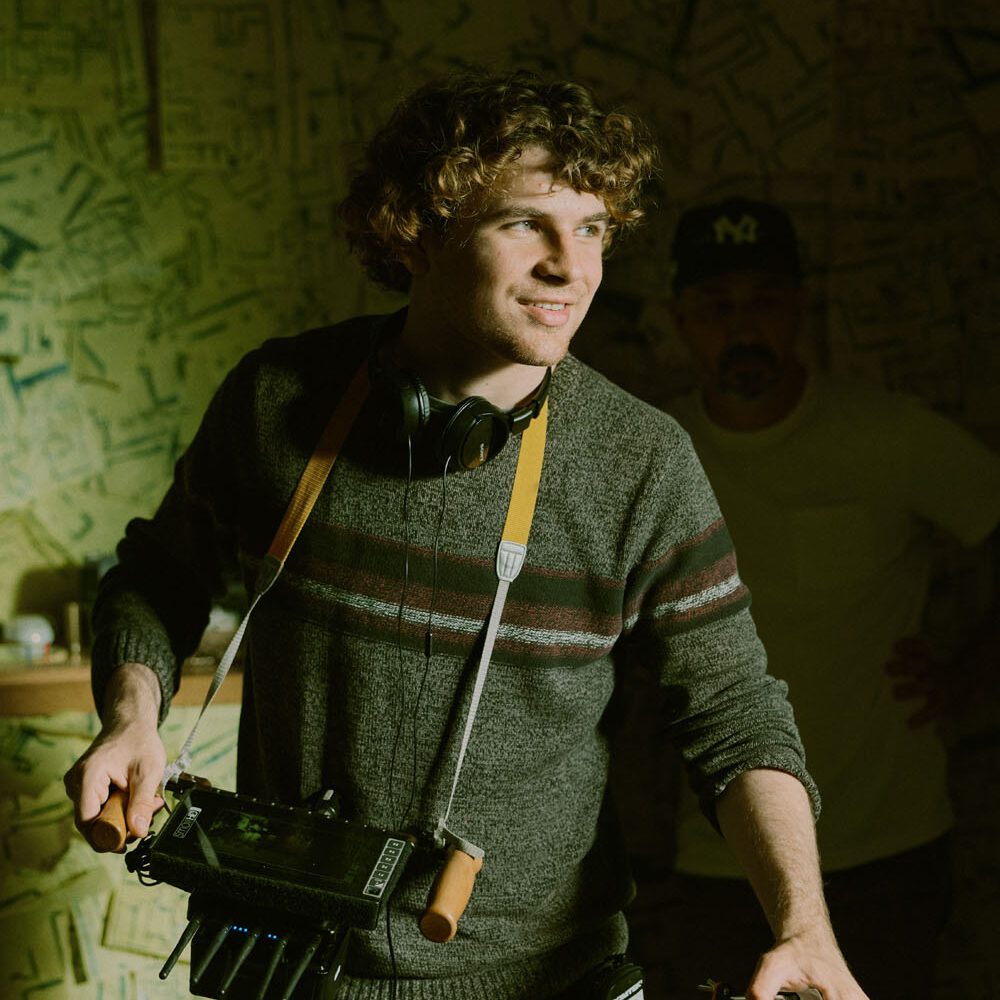
Talking to Kane Parsons is a bit like wandering through the halls of the backrooms with which he’s become so inextricably linked. He speaks at length about his interests, which are myriad and each bear the weight of his full attention. Every time you come to the end of one subject, you find yourself headed into another, which, if interviews weren’t by necessity timed, seem unlikely to reach an end.
We spoke ahead of the release of Backrooms, Parsons’s debut feature, which has lore nearly as unwieldy as its interdimensional setting itself. It all begins with a photo of a staid retail building interior posted on 4chan in 2019. “If you’re not careful and you noclip out of reality in the wrong areas, you’ll end up in the Backrooms,” the accompanying text warned. “It’s nothing but the stink of old moist carpet, the madness of mono-yellow, the endless background noise of fluorescent lights at maximum hum-buzz and approximately six hundred million square miles of randomly segmented empty rooms to be trapped in.” In 2022, a 16-year-old Parsons took the “creepypasta” concept and began uploading a YouTube series of “found footage” in which people explored the various rooms, something lurking in there with them all the while. It racked up 192 million views.
The success attracted the attention of production companies, including Shawn Levy’s 21 Laps and James Wan’s Atomic Monster, neither of which were put off by Parsons’s total lack of professional filmmaking experience, and instead decided to go in together on his first feature with A24’s backing. Ten million dollars were allocated to the budget. Thirty thousand square feet of backrooms were built by set designers based on Parsons’s Blender renderings. New gen horror director Oz Perkins also came on to produce. Renate Reinsve, Chiwetel Ejiofor, and Mark Duplass lead the cast. It’s such a sublime setup for a 20-year-old novice director that more cynical corners of the Internet, the same one that birthed Parsons, speculated he had little to do with the making of his own movie—serving instead as a figurehead for a fertile online IP. “We all know Kane Parsons absolutely didn’t direct this movie,” wrote one user on X, prompting a swift retort from Duplass: “When I was there, Kane was 100% in control. More so than many directors 3x his age.”
Parsons is remarkably nonplussed about it all ahead of opening weekend. For good reason. Backrooms is projected to earn $40-50 million, which would double A24’s opening weekend record (currently held by Civil War at $25 million). What’s more, the way he describes asserting himself before IP-minded studios leaves little doubt that this is someone with stake in both the expression and legacy of their work. Parsons is sharp, to be sure, perhaps most so for his willingness to lean on the veritable masters of form around him. His ascent is something of an unexpected sign from the all-powerful hand of Hollywood that fresh ideas now matter more than proven box office bankability. When did it become audiences, rather than studios, who were the cynics?
How are you feeling this close to the release of the film? Is it a load off, or is this where it ramps up?
No, this is the easy part. We were in major crunch mode finishing this film. It’s a very strange feeling to finish a film and then premiere it literally a week later. I’ve never done a press tour before, and the amount of talking I’ve done in the past week is probably more than I’ve done in the past year combined—and I directed a movie, which is saying something about how much press we’ve been doing.
Can you tell me about how you thought through taking this web series and turning it into a long form piece?
I knew from the beginning, even before I knew this feature film possibility was on the table, it was gonna leave the found footage medium of the YouTube series. I feel the found footage medium is inherently not the most effective for certain narrative choices I wanted to be making, stuff that allows us to take a step back and reassess the situation and the concept.
We’re just looking at, like, what’s an expression of the original concept, the original post that gained so much traction? People have a hard time articulating why this image stands out to them. The characters we have, they’re attacking two of the more obvious avenues in what the backrooms are and the things that come up in conversation—being the attachment to the architecture and the way that we as mammals engage with our environments in a very physical, spatial way, how the nervous system regulates itself. I’m gonna talk about the stuff in an overly technical, science fiction-esque way just cause that’s of course what I do.
The differences seem obvious, but what stood out to you between working on a smaller form project with the people around you and working on a production of this scale with the amazing lineup of collaborators that you have here? Did you enjoy that scale?
I very much did, yeah. The hardest part has been having this very extreme level of attachment. I feel it’s critical as the person directing this project and this entire series that you don’t go and betray the contract you made with the audience. You don’t retcon things and you don’t suddenly lose track of what has otherwise been a very cohesive narrative.
That’s just not fully traditional when you’re doing a feature adaptation of an Internet IP. There’s this very strong desire to start fresh. It’s just always been like fighting a force of nature, with that being the average desire of all parties, and needing to counterbalance it constantly with making swaps and decisions to ensure that it stays consistent with what people are actually looking for in this movie. These Internet indie projects can sometimes evolve when reaching a new group.
There’s no malice about it, but [it’s a] very real scenario where the people who are adapting the thing have not been with the conversation online and are not part of the fanbase and are not familiar with the mythology in the way that would be required to make something that feels like it has the DNA of the thing that came before. It’s been about upholding the genetic makeup of the project, rather than letting it become a costume worn by a different film. I feel really glad that we got there.
It’s an interesting way to go into a film—to have people reach out and say, “We know you haven’t made a film before, we want to teach you.” It seems like maybe you didn’t even consider yourself a film guy beforehand. Sometimes when young filmmakers go in, they’re fresh out of film school and they’ve seen every project ever made.
Did it feel like an odd way to go into a project, or was it beneficial to bring a different perspective?
It didn’t feel odd to me because it’s how I’ve been doing stuff for ages, ever since I was about 10 or so. It didn’t really matter that it was a learning curve to all this, psychologically, at any given point in time. Any free time I had, anything that I could afford to put towards a given project, whatever my obsession of the week slash month slash year was, it would all go towards that project. It feels very much like that’s just what I do, and it’s what I enjoy doing, it’s what I want to keep doing. Even though I was still only 16 when we started this conversation of doing a feature adaptation, I haven’t felt really an ambiguity around, like, Am I doing this right? Am I doing filmmaking right? Because people are clearly getting the ideas that I’m trying to convey, and I am enjoying what I’m doing.
I have a lot to learn. My brain is not even close to being done developing. But any notion that you gotta course correct and start getting into film in the way you’re supposed to or something, that’s just a cultural pressure or bias that doesn’t actually have much in the way of legs. My inspirations obviously trickle down from filmmaking; I watch film, I watch television, I engage with the medium, but maybe in less of a go to the theater as a kid, see a film, and then have stars in your eyes and be like, “This is what I want to do for the rest of my life” [kind of way]. Not to say that the experience of going to a theater isn’t magical, but I would say it’s more that I am a very creatively obsessive kind of person.
You mentioned your brain hasn’t finished developing. There’s been a lot of conversation about how young you are and how new you are to this. Do you feel ready to move past that conversation and get a little bit older, get a little bit more experience, or are you enjoying being in this space?
I’ve been ready to move past it since I was 16, probably. I don’t really care. It doesn’t affect anything in my life whatsoever, really. If I had to be objective about it, I’m sure it makes for better headlines, which makes for better press attention, which somehow is helpful, in some ways, so I guess I should be grateful for it. There’s a lot of people who were very generous to me. Atomic Monster and 21 Laps, them going out on a limb to not just want to engage with the backrooms, but really put me at the center of it—there’s stuff like that. I still am trying to figure out why and how these things happened and how the YouTube algorithm carried my stuff off in the way that it did.
Is there a mentor that you’ve looked to through this process?
I wouldn’t say mentor insofar as an actual in-person relationship rather than random YouTubers I took advice from. On this specific project, I found a very great level of collaboration and help from Chris Ferguson. He has really helped make sense of a lot of things for me with the current situation. He’s been working with Oz Perkins, and Oz has been great too, but Oz has been very busy with his own work.
Oz was a great creative defense. He absolutely got what the source material was and just wanted to protect that. He’s just pro artist, if that’s not very obvious. Chris has been very helpful configuring things in Vancouver [where Backrooms filmed] in such a way that I’m able to come in here with my way of doing things and let everyone else work around that. I’ve obviously deferred to people as well, and we found a happy medium.
Is there a misconception that you had about working on a film set, where once you showed up, you were just like, “This is not how I anticipated it”?
I had the social paranoia in my head that [with] the age thing and having not done this before, there would be a higher amount of things I would either do wrong or be unaware that I’m supposed to be doing, like etiquette things. I was very paranoid about that and I think it was fine cause it was a good time on set and everyone had fun. I’m surrounded by people who are my friends and would tell me at the end of the day.
That’s the same trait in my mind of getting concerned about what is the correct way to be a filmmaker, when in reality, there’s many different ways to achieve the end result, as long as the end result is this final rendered video file with an audio track. [You have] to really focus on it from that technical perspective and understand that you’re just here with a bunch of people who know how to do their jobs pertaining to these specific pieces of equipment, and then these actors are obviously bringing a tremendous amount of their own intuition and insight to these characters. I have an answer to any question they could ask. It’s like, everything we need to make a film is here and it’s happening, so I don’t care if the etiquette is maybe slightly different than normal, because it doesn’t actually matter for the audience.
I like that your answer is, “I’m better at this than I thought I was going to be.”
It’s a testament to just how great the crew was.
It’s always been a draw for me. I guess I’m not a big genre person insofar as I don’t really think about the genre when going into a project. My wish is just to continually hide the medicine in the sugar a little bit, so to speak. I’m trying to grapple with something that I want to digest and interpret, as critically as I can inside a narrative container… Shit, what was I just saying? I’ve been doing this too long and now my brain is atrophying.
Oh yes, I like making sure that there’s something to dig into at the root of this, of anything I make, that is actually more than just a creative whim that is felt out. Horror, anything that gets into a place where you’re inducing a great degree of stress in people, I think I enjoy. I need to interrogate it more because it’s one of those things that goes so far back in childhood that I don’t even know where it started. It’s just a gravitational pull I can’t escape of wanting to create experiences that bring people right up to the uncomfortable edge. A lot of horror scenarios just come from dealing with the unknown, and I like it when it’s an unknown system, usually a human system or a facet of humanity that feels foreign to us.
It feels a little bit like life as a digital native, someone who grew up in this liminal unknown space, as you’re talking about the root of putting someone in an uncomfortable element. I certainly felt like that when I was watching the film—I’m in an A.I. horrorscape.
Okay, good. It was made for something a little bigger than just that, quite a bit bigger, but the use of generative A.I. and our current over-reliance on it and the way that industry is being propped up is definitely a symptom of the bigger systemic problem that the film was responding to, and in the art direction you can kind of see that.
Is there a best response you’ve gotten from a fan of your work, even something you read that someone commented online?
My favorite project I’ve ever done would be The Oldest View. It’s related to this mall in Dallas that was demolished in 2023. That project involves spending most of 2023 doing a one-for-one remake of the mall inside Blender, every little detail, every piece of signage, every label. A couple friends on Discord, we just spent every day, as much as we could, through the night, just combing through old Facebook groups, anything we could to get reference images of the building. There was this giant pageant puppet that we found as many references as we could have. We made the whole mall, we got blueprints from Dallas City Hall. It all looks like real footage in the end.
There would be comments from people where that was their childhood mall. That puppet was real, but it was not a famous mall. There’s nothing that would scream horror property or anything novel about this mall whatsoever. There’s nothing about it that would dictate that someone would spend a whole year remaking it only a couple years after it was demolished. For the people who actually grew up going there and remember seeing that giant when they were a kid, they thought that memory was gone. They never had to think about it again, and somehow they’re coming across a video which feels tailor-made for them. It’s personal to a degree that there’s no rational explanation for.
Maybe it’
This article was originally published by Cultured Magazine.