See Inside the Art-Filled Obama Presidential Center
By Ted Loos
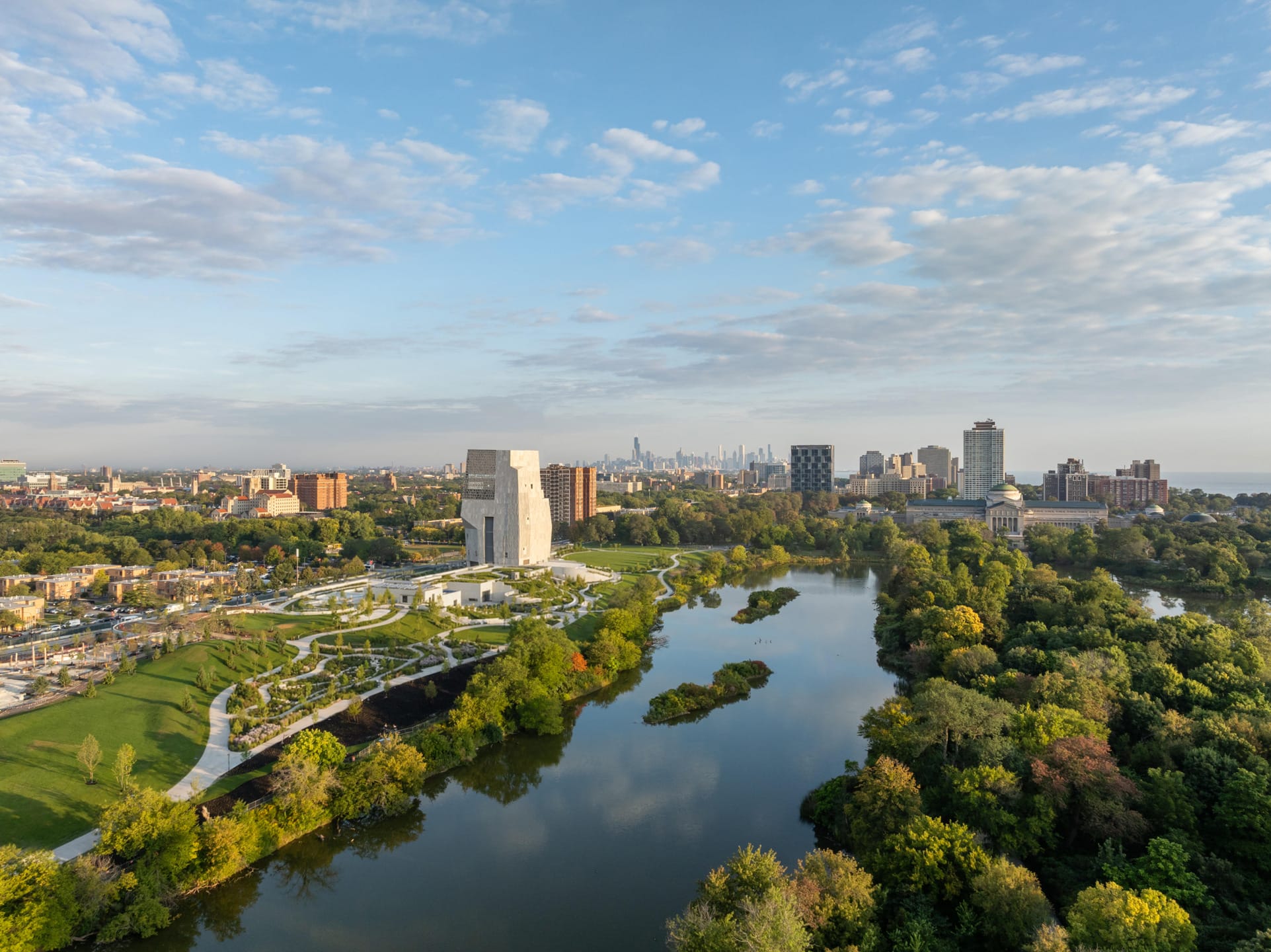
The Obama Presidential Center in Chicago has one of the most impressive contemporary artist lineups around, one that is better and more extensive than many major art museums. Mark Bradford, Theaster Gates, Julie Mehretu, Martin Puryear, Jenny Holzer, Jeffrey Gibson, Kiki Smith, and Rashid Johnson are among the 30 makers whose works are featured at the Center, officially opening June 19.
As I discovered on a sneak peek tour in early April, the art is woven through the many parts of the Center, which is a multi-functional institution with a museum focusing on the history of the Obama presidency; a recreation and sports facility; and a branch of the Chicago Public Library, all set on a 19.3-acre campus.
The building, designed by Tod Williams Billie Tsien Architects, rises up powerfully over the South Side landscape as a faceted, irregular totem of sorts, clad in swirling, textured granite. Inside, the finishes are deluxe and expensive-looking (bronze accents abound), but also friendly and warm.
Originally, there were going to be “five or six artists” at the Center, says Louise Bernard, the founding director of the Obama Presidential Center Museum, who began the job in 2017. Needless to say, there was a joyous expansion along the way, which was partly a function of wanting to activate (and fill) the Center’s expansive layout.
Virginia Shore, who previously curated art for U.S. Embassies when President Obama was in office, served as official curator of all the Center’s art commissions. Bernard tells me that the parameters were to find a list that included “not only established artists but emerging ones, a strong Chicago representation, and an international dynamic” as well as one that would include broad “race, ethnicity, and queer representation.”
Julie Mehretu did her first stained glass work for the Center, an 83-foot-high mural called Uprising of the Sun, which forms a wall of the building, and it can be seen from miles away. Mark Bradford’s thickly painted, highly textural work City of the Big Shoulders is a huge piece that wraps around a balcony and dominates an atrium; it’s a stylized map of Chicago that casts a striking spell.
Maya Lin made Seeing Through the Universe, an outdoor water sculpture, and Njideka Akunyili Crosby has painted an as-yet-unveiled first official portrait of the Obamas together. Although in some cases the curators suggested a medium or approach based on the space where a work would go—like Mehretu’s stained-glass mural—mostly artists had “free reign with the commissions,” says Bernard.
All of the works relied on feedback from the President and First Lady, none more than Idris Khan’s Sky of Hope, a site-specific painting made up of thousands of hand-stamped words from President Obama’s famous Selma speech, given in 2015 to mark the 50th anniversary of the Civil Rights march from Selma to Montgomery. Shore contacted Khan, thinking he would be the right person to work on the Center’s highest space. The speech’s words rise along part of the ceiling as it narrows to a skylight.
Khan, who notes that he is the only British artist featured at the Center, often works with text in his pieces. “But usually it’s my own poetry,” he tells me, noting that using the Selma speech was “such a lovely idea.” He used his signature shade of blue for the text. “It was a wonderful emotional moment, having those words in our head all that time,” Khan says, though he notes that working on a scissor lift and reaching up to the ceiling to stamp for days on end meant that “my neck was killing me by the end.” The results are even more powerful than he imagined. “People come in and start crying,” he says.
The way the art is installed means that you are not always expecting it. Coming up a staircase off the main lobby, visitors see a hanging piece by Nick Cave and Marie Watt, who had never collaborated before, called This Land, Shared Sky, made of beaded nets and jingles. A private dining room has a painting by Hugo McCloud, Hidden Reflection, that mixes references to meaningful geographic locations in President Obama’s life and turns them into a thoughtful reflected landscape.
As Bernard tells it, the spread-out installation is meant to make the art digestible and appreciable to visitors of all kinds. “It breaks down the barriers that people sometimes feel around museums,” she says. “They can be very kind of intimidating spaces.”
Since inclusivity was a core principle of the Obama administration, and of the Obamas’ time in office more broadly, the art program’s ethos had to match that. “We want to ensure that within the walls of the space that people—especially our most immediate constituency, local residents—feel a real sense of welcome and ownership and belonging in the space,” says Bernard. “One way to do that is to enliven it with art.”
This article was originally published by Galerie Magazine.
