Artist Lee Ufan, Who Turns 90 Next Month, Will Change How You Feel About Time
By By Julia Halperin
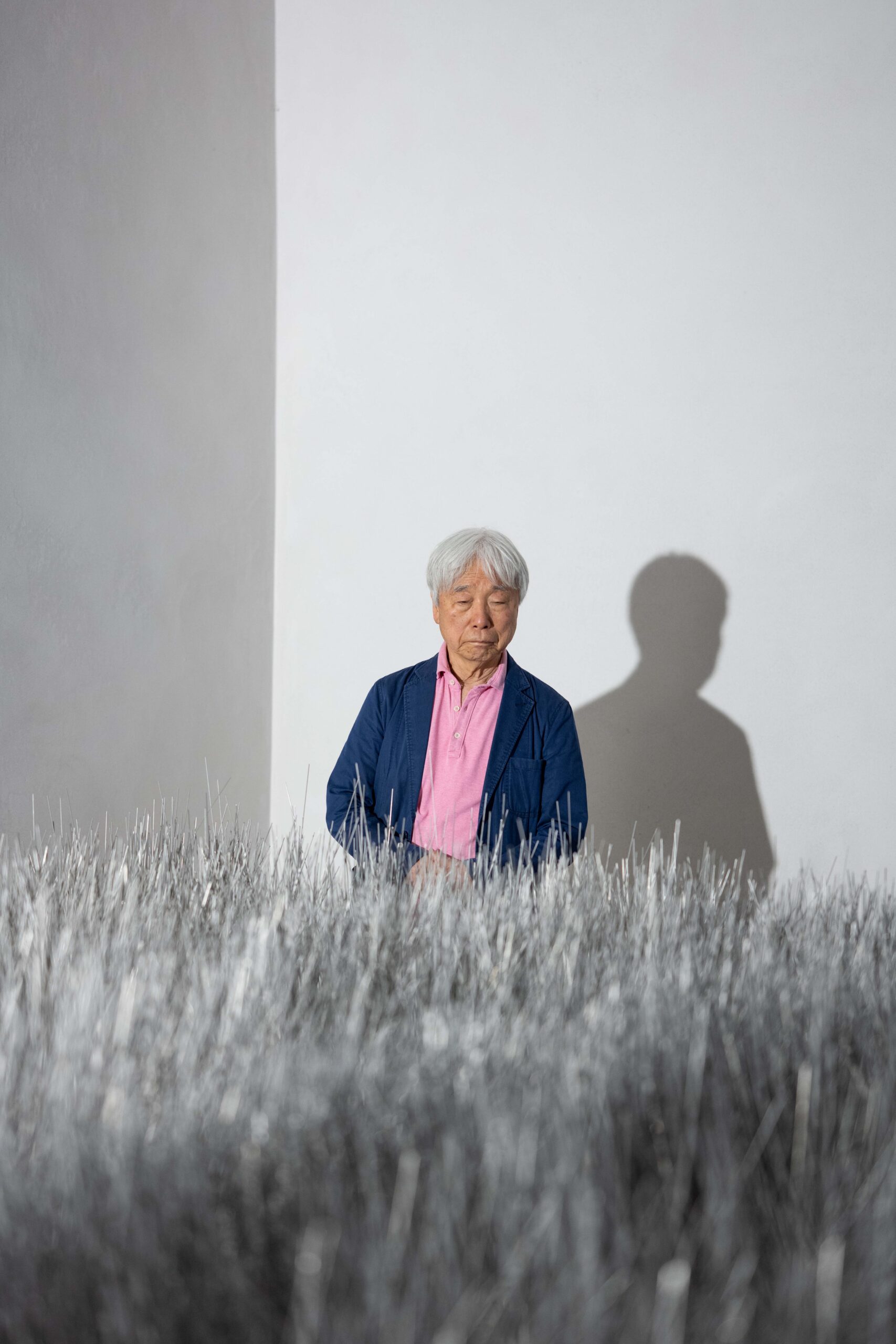
I arrive at Lee Ufan’s home huffing and puffing.
For almost six decades, the 90-year-old artist has created spare, meticulous paintings and sculptures that somehow manage to slow time and heighten our awareness of our bodies and breath. Greeting him with a dry throat and elevated heart rate seemed at odds with the contemplative spirit of his work. But we were running late.
Three other journalists and I had accidentally gotten off the bus one stop early on the way to visit the artist, who is deferentially referred to as Mr. Lee by those around him. Terrified that we might keep him waiting—a far graver faux pas in Japan than in the West—our guide, a local exhibitions manager, took off in a sprint. That’s how I found myself trotting behind her through a quiet street in Kamakura, the coastal city an hour outside Tokyo where Ufan lives and works.
Even before we broke into a jog, there was a bit of an “off to see the wizard” vibe to the proceedings. We’d spent the past two days in Naoshima, the transcendent art island that houses a museum dedicated to Lee’s work. We’d seen the chapel-like gallery he’d adorned with one gray lozenge-shaped gradient on each wall and the skinny steel obelisk he installed just outside the low concrete building. (The placement of the sculpture initially blindsided—but ultimately pleased—the building’s architect, Tadao Ando.) Now, we were about to meet the man behind it all.
The occasion for our visit is three major exhibitions of Lee’s work around the globe: a focused presentation of paintings and sculptures the artist donated to the Dia Art Foundation in Beacon, New York (on long-term view), an elegant retrospective overlooking Saint Mark’s Square that coincides with the Venice Biennale (through Nov. 21 at the San Marco Art Center), and a collection of new indoor and outdoor works at the Serralves Foundation in Porto, Portugal (opening in September).
Lee, who lives between Kamakura and Paris, is perhaps best known for the rhythmic paintings of lines and dots he created in the 1970s and ’80s. To make them, he dipped his brush into (usually royal blue, sometimes vermilion) paint and applied it to the surface of the canvas until the brush ran dry. During each stroke, he held his breath; the repetitive cycle from fullness to emptiness played out in his body and on the canvas simultaneously.
The artist’s sculptures—somewhat lesser-known than his paintings, even though he started making them first—are arrangements of industrial materials, like metal plates or steel, placed in proximity to a carefully chosen rock or two. The relationship between the manmade and the natural worlds creates a kind of magnetic charge.
In a time of endless virtual inputs and noise from every direction, Lee’s work asks the viewer to “take the time to slow down, to reflect, to meditate on what it is that he’s made,” says Jessica Morgan, Dia’s director and the curator of the Venice exhibition.
Lee greets us at the back door of his modest wooden home. (We are three minutes late; he does not seem too concerned.) Like many people whose reputations precede them, he is slighter in person than I imagined. Outfitted in gray socks, jeans, and a crimson half-zip sweater, he also looks about two decades younger than he is.
For an artist whose work is quiet and nearly impossible to reproduce in images, Lee has managed to accrue admirers the world over. Collectors have paid more than $2 million for his paintings. He has three dedicated museums (in addition to the Tadao Ando-designed temple in Naoshima, there are spaces in Arles, France, and Busan, Korea) and has been the subject of major exhibitions at venues including Versailles, the Guggenheim Museum in New York, and the Hamburger Bahnhof in Berlin.
During much of his adult life, Lee has felt that he didn’t quite fit in anywhere. Born in Japanese-occupied Korea, he traveled to Japan as a young man to deliver medicine to an ill uncle and decided to stay. He studied philosophy and joined forces with a group of Japanese artists to form “Mono Ha” (School of Things), whose members created art by arranging existing objects rather than creating new ones. While Lee was a central member of the group (as well as its in-house philosopher), he was excluded from several exhibitions, including an important show at the Guggenheim in 1970, because of his Korean identity.
“Koreans see me as being Japanized, the Japanese see me as being fundamentally Korean, and when I go to Europe, people set me aside as an Oriental,” Lee has said. “I am left standing outside the collective, seen on the one hand as a fugitive and on the other side as an intruder. The dynamics of distance have made me what I am.”
Lee’s oeuvre, like his life, straddles national borders. While his sculpture is associated with Japanese Mono Ha, his painting is affiliated with Tansaekhwa, a loose group of Korean artists who used distinctive processes, like pushing paint through burlap or peeling it from the surface, to make spare, minimal compositions. He was first inspired to paint after seeing the work of an American artist—the Abstract Expressionist Barnett Newman—in New York in 1971. “What I want to express is not something Eastern or Western, but a different horizon altogether,” Lee tells me over tea through a translator at his studio.
It’s notable that while the Dia Art Foundation organized our trip, it was Lee who paid for it, including a business class ticket from New York to Tokyo. As the author of 17 books, he presumably believes in the importance of critical engagement. But it’s still somehow surprising that he feels anything more needs to be done to secure his legacy.
“Once you reach a certain age, everyone—museums included—starts encouraging you to do a retrospective,” Lee says. “And through that process, you come to feel your own limitations. You start thinking about taking the things you already possess and carrying them to a higher place, in their most essential, distilled form.”
Lee is still working to get audiences to understand that the negative space in his work is as important as the positive space. “Say there’s a large canvas I’ve been painting, and there’s just one stroke on it. A photographer will photograph only the stroke and publish that. So the unpainted areas are completely ignored. That kind of thing leads to tremendous misunderstanding,” he says.
The artist’s work and outlook both possess a kind of restraint that is somewhat anathema to contemporary life, where more is more. Philippe Vergne, the director of the Serralves Foundation, fondly recalls a disagreement over the scale of the exhibition catalogue, which includes the first translations of Lee’s writings into Portuguese. “I wanted many texts, and he selected two,” Vergne says.
Lee is still looking ahead. He continues to paint every day, and in the past few years, debuted a new series, “Response.” These gradients incorporate more movement—a kind of undulation of the paint—and richer colors than he’s ever used before. “For an artist who’s been so consistent, it’s actually a pretty dramatic move,” Morgan says. Even though the marks look like a single stroke, Lee builds them by layering many small ones; the process can take up to a month. Rather than recording the passage of time, as he did in the “From Point” and “From Line” series, this new approach is, Lee says, about “expressing spatiality through the accumulation of time.”
The artist also shows signs of softening—even loosening up—in his later years. His daughter, Bona, notes that he has made new friends (who have nothing to do with the art world) in his 80s, after living most of his life with a regimented, singular focus. “Every Sunday, he goes to have tea [with them],” she says. “The family was very, very surprised to see that.”
After I leave Lee’s home, I think back to a plate sitting on a wooden chest in his living room. There was a browning, slightly shriveling lime next to a short, bright red brushstroke. It was presumably not intended for an audience, or even intended to last. But it embodied so much about Lee’s work: the juxtaposition between the natural and human-made, and the way art can suspend time but also reflect its progression back at you.
“What’s essential is the desire to improve—not like a machine going through the motions, just mechanically repeating,” Lee tells me toward the end of our interview. “But within the human heart, I think it’s possible to aim for something truly other, another dimension entirely.”
More of our favorite stories from CULTURED
The A.I. Revolution Has Come For Next-Gen Jobs. Jodi Kantor Sees a Way Forward.
72 Hours in Venice: Palazzos, Protests, and a Biennale on the Brink
Air de Paris, a Radical Stalwart of the French Gallery Scene, Is Closing
Who’s The Next Obsession? 12 European Collectors Reveal How They Discover New Talent
For His Next Act, Kareem Rahma Is Going Beyond Hot Takes
Sign up for our newsletter here to get these stories direct to your inbox.
Sign up for a digital subscription, starting at less than $3 a week.
Sign up for a digital subscription, starting at less than $2 a week.
You’re approaching your limit of complimentary articles. For expanded access, become a digital subscriber for less than $3 a week.
For less than the price of a cocktail, you can help independent journalism thrive.
For less than the price of a cocktail, you can help independent journalism thrive.
You’re approaching your limit of complimentary articles. For expanded access, become a digital subscriber for less than $3 a week.
For less than the price of a cocktail, you can help independent journalism thrive.
Support independent criticism for $10/month (or just $110/year).
This article was originally published by Cultured Magazine.
