
Blue Tilt
<p>Since the 1970s, Jenny Holzer has used language as her medium of choice to communicate penetrating ideas about life and death, sex, power, and war. Like contemporaries including Barbara Kruger, Sherrie Levine, and Cindy Sherman, she appropriates mass media and advertising strategies in her work. Holzer rose to prominence with her <em>Truisms</em> series (1977–79), which consisted of nearly three hundred aphorisms and slogans that play on commonly held truths and clichés such as “A lot of professionals are crackpots” and “A man can’t know what it is like to be a mother.” Displayed as anonymous broadsides on buildings, fences, and walls throughout Manhattan, these statements were meant to provoke public debate. In her more recent work, Holzer continues to use language and current modes of communication to assail established ideas about art’s place, audience, and meaning in modern society. Her texts have appeared on benches, billboards, Internet sites, posters, sarcophagi, in the form of monumental Xenon projections, and, most commonly, as LED (light-emitting diode) signs.<br><em>Blue Tilt</em> features texts from five of Holzer’s iconic series: <em>Truisms</em>; <em>Inflammatory Essays</em> (1979–82), one hundred words in twenty lines inspired by the literature of Emma Goldman, Rosa Luxembourg, Lenin, Mao, and others, also printed on posters; <em>Living</em> (1980–82), matter-of-fact writings on “everyday life with a twist” that were originally shown on cast-bronze plaques and hand-lettered metal signs; the urgent <em>Survival</em> (1983–85), which appeared on the Spectacolor board in New York’s Times Square and was the first series the artist conceived for electronic signs; and the desperate <em>Under A Rock</em> (1986), which was engraved on stone benches shortly after Holzer’s move to the countryside of upstate New York. Although all of these texts are the artist’s invention, they do not necessarily reflect her personal views. Indeed, they employ a variety of contradictory voices, assuming a tone of anonymous authority in order to express a wide spectrum of biases and beliefs in which truth is relative. <em>Blue Tilt</em> captures each of these signature moments in the medium most readily associated with Holzer—the LED.<br>The structure of <em>Blue Tilt</em>’s installation is architectural and dramatic, with imposing sixteen-foot, double-sided signs towering over viewers and bathing the entire space in the light of a relentless stream of words. “One reason I’ve stayed with LEDs so long,” remarked Holzer, “is that part of the experience is that the light and words hit the body. This might give you vertigo; it might represent that there’s always too much information and ‘how do I process it?’ It could make you unsure of the floor; I try to use reflections to that end.” Under her control, the gallery becomes a stage that at once creates and serves an audience that can no longer make itself comfortable.</p>
Catalogue
- Year
- 2004
- Dimensions
- 381 × 13.7 × 13.7 cm (150 × 5 3/8 × 5 3/8 in.), each unit; 381 × 228.6 × 127 cm (150 × 90 × 50 in.), installed
- Collection
- Art Institute of Chicago
- Artist
- Jenny Holzer
Artist

Painting
Jenny Holzer is an American neo-conceptual artist based in Hoosick, New York. Her work focuses on the delivery of words and ideas in public spaces and includes large-scale installations, advertising billboards, projections on buildings and other structures, and illuminated electronic displays.
Full artist profile →More
More by Jenny Holzer

Protect Protect
2007 · Oil paint on canvas

Phase I... Running Start Shape the Battlespace pewter
2007 · Oil paint on canvas

Force at End of Phase III (If Required) violet
2007 · Oil paint on canvas
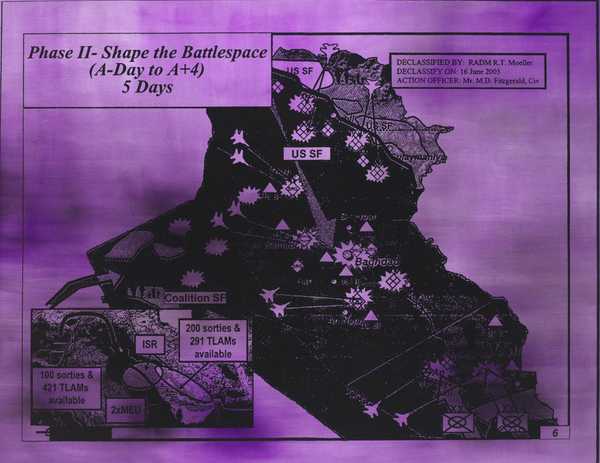
Shape the Battlespace
2007 · Oil paint on canvas
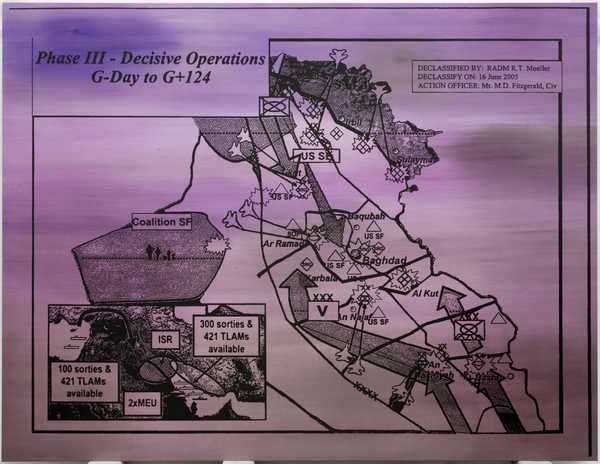
Phase III - Decisive Operations violet
2007 · Oil paint on canvas
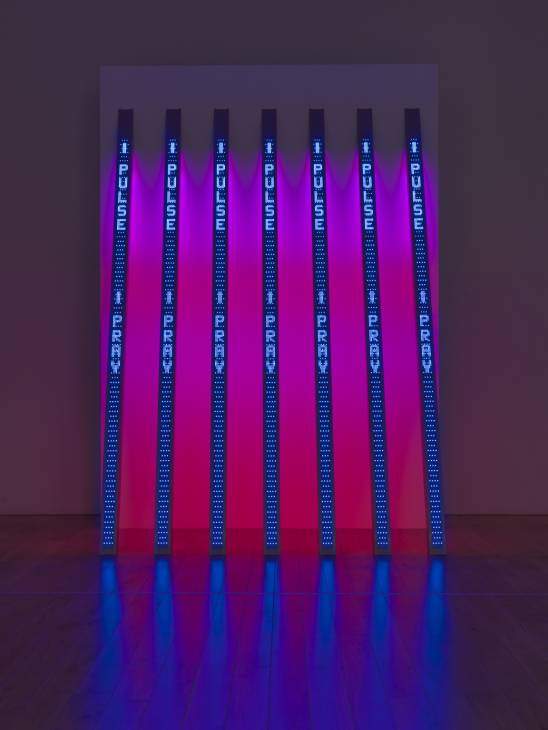
BLUE PURPLE TILT
2007 · 7 light emitting diode columns
Record
Verified by WattsOS- Artist
- Jenny Holzer
- Year
- 2004
- Dimensions
- 381 × 13.7 × 13.7 cm (150 × 5 3/8 × 5 3/8 in.), each unit; 381 × 228.6 × 127 cm (150 × 90 × 50 in.), installed
- Watts ID
- WW-2004-130809
Source
- Collection
- Art Institute of Chicago
- Source
- aic
- Reference
- View at source
- Status
- verified