
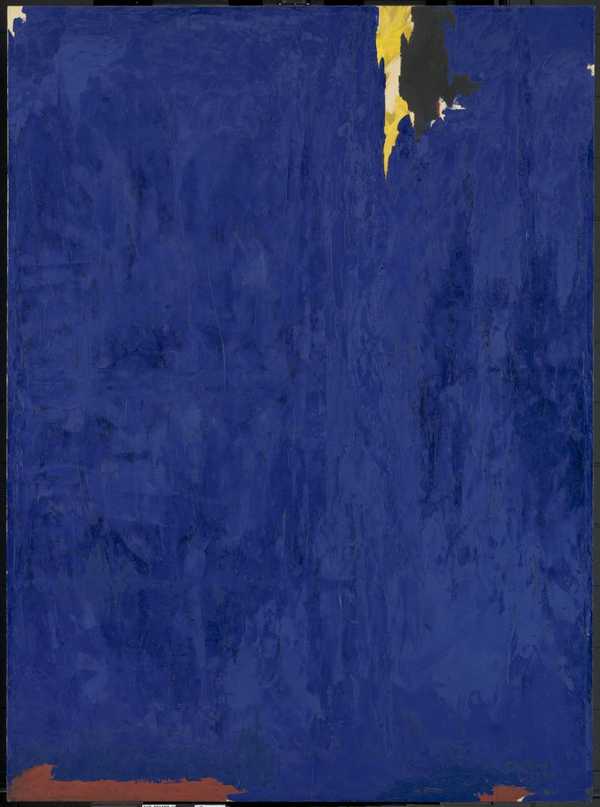
<p>In the late 1940s, Clyfford Still, along with Barnett Newman and Mark Rothko, originated the type of Abstract Expressionism known as Field Painting, a term used to describe large canvases dominated by one uniform color or a few colors closely related in hue and value. In contrast to Newman and Rothko, who usually applied paint thinly and uniformly, Still used a palette knife, creating textural effects that give the surface a complex, nearly sculptural sense of materiality. Named after the years of its creation, <em>1951–52</em> is a rare, nearly all-black work in the artist’s oeuvre. A vertical white line to the right of center and a thin streak of red-orange along the left side provide the sole interruptions in the black field. The subtle modulations of texture and finish support the artist’s claim that "I do not oversimplify—in fact, I revel in the extra complex."</p>
Catalogue
- Year
- 1951
- Medium
- Oil on canvas
- Dimensions
- 301.8 × 396.2 cm (118 3/4 × 156 in.)
- Collection
- Art Institute of Chicago
- Artist
- Clyfford Still
Artist

Painting
American painter Clyfford Still was one leading figures in the first generation of the Abstract Expressionist movement, which developed in America following the Second World War. Today, the majority of the artworks from Still's estate are housed in the Clyfford Still Museum in Denver, Colorado. Given this, it is quite rare for artworks by Still that comes to market.
Full artist profile →More
More by Clyfford Still

Record
Verified by WattsOS- Artist
- Clyfford Still
- Year
- 1951
- Medium
- Oil on canvas
- Dimensions
- 301.8 × 396.2 cm (118 3/4 × 156 in.)
- Watts ID
- WW-1951-134659
Source
- Collection
- Art Institute of Chicago
- Source
- aic
- Reference
- View at source
- Status
- verified