
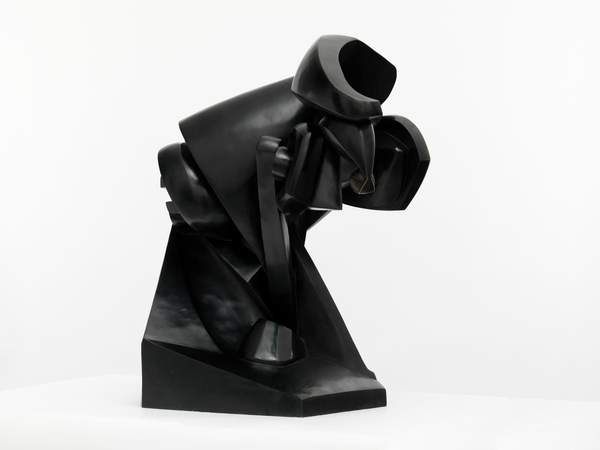
<p>Writing in 1913 to his friend the American art historian Walter Pach, Raymond Duchamp-Villon declared, "The power of the machine imposes itself upon us and we can scarcely conceive living bodies without it." That year the French sculptor began his preliminary sketches and clay studies for <em>Horse</em>, progressively abstracting these initial naturalistic renderings of the animal’s anatomy into a coiled configuration of geometric forms suggestive of pistons, gears, and shafts. Optimistically embracing the clean aesthetic and dynamic potential of the machine, Duchamp-Villon reinterpreted the traditional subject of equestrian sculpture for the modern era. The artist completed only a small plaster of the final version of Horse; he died before he could realize his plans to enlarge and cast it in bronze. This was done by his brothers, Jacques Villon and Marcel Duchamp, in 1930–31.</p>
Catalogue
- Year
- 1914
- Medium
- Bronze
- Dimensions
- 99 × 61 × 91.4 cm (39 3/8 × 24 × 36 in.)
- Collection
- Art Institute of Chicago
- Artist
- Raymond Duchamp-Villon
Artist

Sculpture
French sculptor Raymond Duchamp-Villon, one of the first to apply the Cubist style in three dimensions, is best known for his dynamic bronze sculptures. Geometrically abstracted, smooth-surfaced and thrumming with energy, his pieces evoke a striking synthesis of muscular and mechanical motion. Working closely with his brothers, the artists Marcel Duchamp and Jacques Villon, Duchamp-Villon was an influential advocate for Cubism in the early 20th century.
Full artist profile →More
More by Raymond Duchamp-Villon




Record
Verified by WattsOS- Artist
- Raymond Duchamp-Villon
- Year
- 1914
- Medium
- Bronze
- Dimensions
- 99 × 61 × 91.4 cm (39 3/8 × 24 × 36 in.)
- Watts ID
- WW-1914-114807
Source
- Collection
- Art Institute of Chicago
- Source
- aic
- Reference
- View at source
- Status
- verified